When should you cash out a scratch-off win instead of buying more tickets?
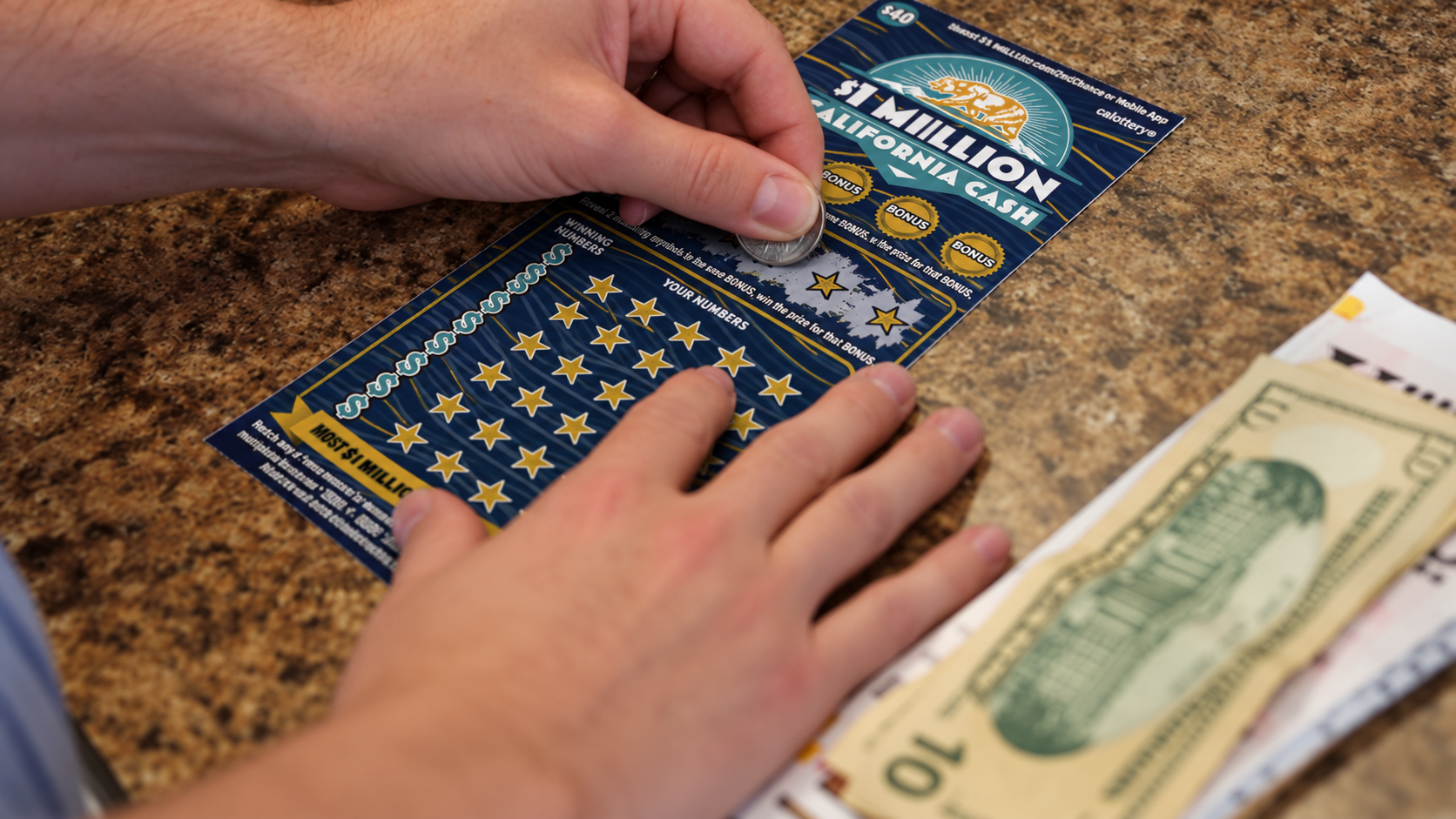
Scratch a $5 ticket, win $20, and the easiest thing in the world is to use that money to buy four more tickets. Plenty of players handle winning anything under $50 that way. By the numbers, the cheapest time to cash a prize is the moment you win it, because a replayed prize goes through the lottery's cut a second time.
Across all active US scratch-offs, $5 games pay back 69.1% of sales as prizes on average, $10 games 72.9%, and $20 games 75.0%. A $20 win spent on $5 tickets comes back to players as about $13.82 on average. Spend that, and about $9.55 comes back. Keep going and it shrinks toward zero.
What replaying does to a $20 budget
To put numbers on it, we ran 400,000 simulated trips to the counter with $20 and the Texas Lottery's Lucky 7, a $5 game with overall odds of 1 in 4.23 and a 68.0% payout, close to the national average for its price. The only thing that changes from row to row is what the player does with a win.
| What you do with wins | Average tickets played | Average cash you leave with | Leave with more than $20 | Leave with nothing |
|---|---|---|---|---|
| Buy four, keep all wins | 4.0 | $13.61 | 18.3% | 34.0% |
| Replay wins under $20 | 5.2 | $11.70 | 15.9% | 68.7% |
| Replay wins under $50 | 7.4 | $8.24 | 11.1% | 88.9% |
| Replay wins under $100 | 9.8 | $4.37 | 2.8% | 97.2% |
| Replay wins under $500 | 11.4 | $1.72 | 0.1% | 99.9% |
| Quit once you are ahead | 4.2 | $13.24 | 33.9% | 66.1% |
| Quit once you reach $40 | 6.0 | $10.35 | 15.9% | 84.1% |
Each trip starts with $20, and tickets cost $5. ‘Buy four, keep all wins’ means buying four tickets and cashing out every prize. For the replay strategies, each individual prize below the stated threshold is spent on more tickets; prizes at or above the threshold are set aside and kept. Play ends when the money available for tickets runs out. Keeping the prizes leaves the most money on average and the smallest chance of walking out empty-handed, which happens only when all four tickets lose. Replaying prizes under $50 buys about three more tickets and leaves 88.9% of players with nothing. Their chance of going home ahead falls too, from 18.3% to 11.1%.
Wins under $50 are nearly all the wins there are. On Lucky 7, 93.1% of winning tickets pay less than $50, and 43.7% pay exactly $5, the price of the ticket. Money-back prizes are that common across scratch-offs generally, so a rule that replays small prizes ends up replaying almost all of them.
Quitting once you are ahead
One rule beats keeping the prizes on one measure. Players who stopped the moment their cash went above $20 left ahead 33.9% of the time, close to double the 18.3% for players who bought four tickets and pocketed the wins. The catch is that two out of three of them left with nothing, because a player who is still behind keeps buying until the money runs out. The two averages came out nearly level, $13.24 against $13.61.
Aiming higher hurts on both counts. Players who held out for $40, double the starting cash, got there 15.9% of the time, and 84.1% went home empty.
This pattern also shows up at higher prices. With the $10 Lucky 7 Doubler, a 70.0% game, keeping both tickets' prizes left players with nothing 54.5% of the time, and replaying wins under $50 did so 88.5% of the time. On the $20 Lucky 7 Tripler, a 75.0% game bought one ticket at a time, the figures were 70.9% and 86.4%.
Another way to see a replayed win is as a fresh budget. Fed back into $5 tickets until it runs out, a $50 prize buys about $160 of play on average at the national payout, or 32 tickets. The same $50 stretches to about $185 of $10 tickets or $200 of $20 tickets. For players who buy scratch-offs for the scratching, that is what the extra play costs, and the yearly cost of a weekly habit adds up the same way.
Small prizes are easy to take as cash. In most of the largest lottery states a store can pay up to $599, and the steps for anything bigger are in how to claim a scratch-off prize.
How we did this. We simulated 400,000 sessions for each rule and game, each starting with $20 in cash. Prize chances come from each game's full printed prize table from the Texas Lottery, with the ticket count derived from its published overall odds; the derived payouts match the lottery's own figures within 0.1 point. A session ends when the player can't afford another ticket or reaches the rule's stopping point. Average cash left is $20 minus the game's house share times the average amount spent, so rare top-prize hits cannot skew it. National payout averages are simple means across all active US games in our data at each price, as of September 24, 2026.
Frequently Asked Questions
Should you use scratch-off winnings to buy more tickets?
Each replay returns the game's payout on average, about 69 cents per dollar on $5 tickets nationally. In our simulation of $20 spent on a Texas $5 game, replaying wins under $50 cut the average cash left from $13.61 to $8.24.
What is a good rule for when to stop playing scratch-offs?
Two rules held up. Keeping all wins left the most money on average and the lowest chance of going home empty. Quitting as soon as you are ahead gave the best chance of leaving with more than you brought, about one in three.
How much of a $50 scratch-off win do you lose by replaying it?
All of it, on average, if you keep going until it runs out. At the national 69.1% payout for $5 games, a $50 prize buys about $160 worth of $5 tickets before it is gone, unless a big prize stops you along the way.

Phil Nageotte is a writer covering scratch-off odds, expected value, prize data, and more. He joined ScratchCheck in 2026 after years of tracking lottery payouts in spreadsheets of his own.